SSL Fusion Violet EQ: Does It Really Add That Special 'SSL Sound'?
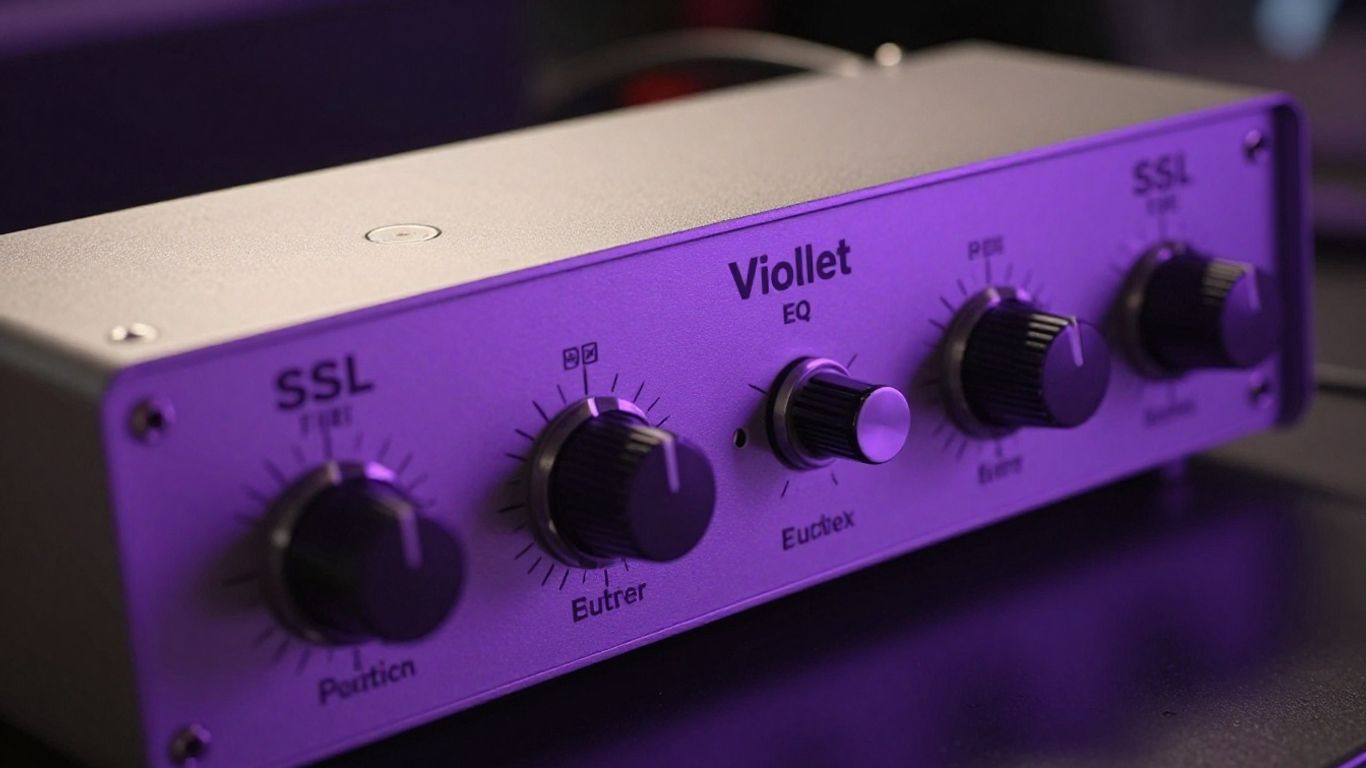
A viewer asked about the SSL Fusion Violet EQ plugin, specifically if it had issues with 'cramping' at the Nyquist frequency. This video dives into that, but more importantly, it explores whether this EQ offers something unique beyond standard EQ plugins, especially for indie producers.
Key Takeaways
- The SSL Fusion Violet EQ plugin does not exhibit 'cramping' at the Nyquist frequency; this was a misinterpretation of the graph.
- The plugin appears to be a clean, linear EQ, with no added saturation or harmonics.
- The input and output gain controls, while present, don't seem to affect the sound in a non-linear way.
- The EQ curves, particularly the high shelf, are calibrated differently than typical EQs, which might lead to different frequency choices based on ear.
- The 'Eco' mode switches from linear phase oversampling to minimum phase oversampling to reduce latency, rather than disabling oversampling entirely.
- For producers who trust their ears, the unique calibration might offer confidence in frequency choices, but technically, similar curves can be achieved with other EQs.
First Impressions And Feature Set
This EQ plugin from SSL has a fairly straightforward feature set. You get a high-pass filter with three cutoff options and a 'fat' button. Then there's a low shelf and a high shelf, each with four frequency choices and a +/- 9 dB gain range. It also includes separate input and output gain controls and an 'Eco' button to remove latency.
The immediate question for any producer is: why use this over the many other EQs that offer mid-range bands and shelves? To justify its existence, this plugin would need something special. This could be unique EQ curves that are hard to replicate, or some kind of saturation magic adding extra harmonics. The separate input/output gains and the use of oversampling hint at the latter, suggesting the gain structure and oversampling filters are important.
Testing For Non-Linearities
One of the first things to check is if the plugin adds any harmonic distortion. By adjusting the input and output gain, you can see if changing the gain structure alters the sound. While it's a bit annoying that you can't link the input and output gain directly in most DAWs, using parameter linking in a DAW like Reaper can help test different gain structures. However, in listening tests, no audible difference was found when adjusting these gains, suggesting the plugin is clean and linear. This means the separate gain controls might be a bit of a duplication.
The EQ Curves: What Makes Them Special?
SSL's marketing talks about 'analog' and 'sheen,' but carefully avoids claims of saturation. The description mentions modeling based on real measurements and collaboration with the original designers. Crucially, there's no mention of saturation or non-linearity.
When it comes to the EQ curves themselves, the high shelf boost, even at its extreme, sounds surprisingly good on a full mix. But the real question is whether these SSL curves sound better or even just different compared to other EQs. This isn't just about matching curves with a plugin like FabFilter Pro Q3; it's about whether you're likely to arrive at a similar curve in the first place.
A quick listening test with different EQs, dialing in the shelves without trying to match anything, showed that while they all sounded slightly different, they were much closer to each other than to the original mix. The SSL didn't stand out as dramatically better. The main difference noticed was that the SSL's high shelf, claimed to be at 8 kHz, was often matched by ear at lower frequencies (around 4 kHz or less) on other EQs.
Under The Hood: Plugin Doctor Analysis
Using a tool like Plugin Doctor reveals more. The harmonic analysis shows no harmonics, confirming the plugin is linear. This means we can safely analyze the curves using linear analysis.
- High-Pass Filter: Looks pretty standard. The 'fat' button, marketed as adding punch, appears to be just a bit of resonance, not dynamic behavior.
- Low Shelf: Also looks unremarkable. It can be closely matched with Pro Q3, though it might require a slightly steeper slope or more gain in Pro Q3 to get an exact match.
- High Shelf: This is where things get interesting. There's a subtle lift above 10 kHz and a steep low-pass filter above 20 kHz. This low-pass filter is part of the oversampling process to prevent aliasing.
Oversampling and Eco Mode
The 'Eco' mode seems to switch from linear phase oversampling to minimum phase oversampling, which reduces latency but might introduce more phase shift. At higher project sample rates (like 96k), the oversampling seems to disappear, and the plugin runs at the native project sample rate with zero latency.
When trying to match the high shelf in Pro Q3, even at 96k, it's difficult to get a perfect match, partly due to the subtle box tone and the characteristics of the oversampling filter. While the curves can be matched closely, the calibration of the frequency controls on the SSL plugin leads to different frequency choices being made by ear.
The Verdict: Is It Worth It?
Ultimately, the SSL Fusion Violet EQ is a clean, linear shelving EQ. The differences in its curves compared to other EQs are minor. The main reason to choose it might be the SSL name and their reputation. The unconventional frequency calibration might give producers the confidence to apply settings, like a high shelf boost at 3 kHz on a full mix, knowing it's 'officially sanctioned' by SSL engineers. If you're insecure about your mixing decisions, this validation might be appealing.
However, if you trust your ears and don't need that external validation, there are plenty of other EQ plugins that can achieve similar results. For many, especially those who already have versatile EQs, there might not be a compelling reason to add this to their collection.
Skip the rabbit hole — our engineer does the EQ math. $250/track master, $800/song mix.